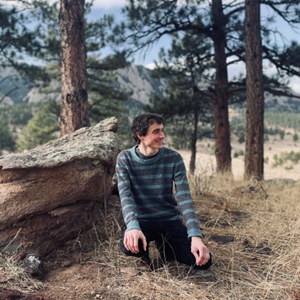
“Strangeland,” the title track and first single from the debut LP from Eyed Jay, arriving on tape/digital April 4th. The song explores the sense of fate and surrender in being drawn to another person. Its fragmented, elliptical imagery sets memories of private moments between two people in relief against natural cycles beyond our grasp – drawing attention to how world-creating these little, human moments can be despite their smallness on a cosmological scale.
Kaleidoscopic, complex and patently gorgeous, Eyed Jay’s Strangeland is perhaps most remarkable for its ability to hold, in tension or in harmony, multiple voices, meanings, tones, or keys, all at once. Strangeland is the debut recording from the project of D.C.-born guitarist Ian Jickling.
“The idea of the same group of basic materials shifting around under the surface to build up strikingly different structures was very important for me throughout the process of making this record,” Jickling says. Coalescing primarily around Jickling’s nimble fingerstyle guitar playing and diaphanous voice, Strangeland is anything but a straightforward guitar-and-voice record.
Waterfalls of crystalline electronics merge with Jickling’s playing and emerge from elsewhere like bursts of light, sometimes gentle and peripheral, while at other times blindingly direct. The fact that these “other sounds” are almost entirely sourced from Jickling’s guitar and voice serves the kaleidoscopic nature here. Like a single source of light shifted into a staggering array of shapes and colors, while still penetrating as light, the sound of Jickling’s guitar and voice spill through a steadily transforming array of peals, pulses, and sprays. Dense as it may often be, this array never obfuscates the source.
Jickling was exposed to obscure psych and experimental music early in life and grew up playing in bands, priding himself on experimentation and a punk ethos style naivete. Such was, for Jickling, something like the family business. His father, Mark Jickling, was a core member of the legendary indie weirdo band Half Japanese. And Ian’s older brother, Paul, waded into the D.C. and Chicago D.I.Y. scenes ahead of Ian, playing in the precursor to post-punk band Black Eyes. While Ian cut his teeth in a similar fashion, a decade-long detour into ethnomusicology and eventually a masters in classical guitar would, in a sense, distinguish him. Jickling threw himself into his practice and virtually cut himself off from any music outside of the classical world for years. In particular, a deep fascination with 15th century Franco-Flemish polyphonic music took root during this time and has proved itself to be one of the more long-standing influences in Jickling’s musical life, alongside those early experiences in the D.I.Y. scene.
 music won't save you